
An artist who bases his practice on cultural traditions that aren’t anglicized? Yes! An artist who ironically anglicizes cultural traditions in his endeavor to portray the distinctive features and relevance of the culture and language he calls his own? Yes! An artist who employs a field as dynamic and immersive as animation to amalgamate his interests in writing and artistic studio practice? YES!
Clearly, I am excited about Xu Bing’s ideas.
(Perhaps not excited enough to write a book consisting of an illegible alphabet of my creation, but intrigued enough by these concepts to try my hand at the illusionary-Mandarin-English that Xu Bing invents for the purpose of his artwork.)
Since there seemed to be so much to unpack from his lecture at the Johnson Museum, I’ve organized my analysis of the same with regard to three different conversations that commenced in my mind thereafter;
(a) The multiway intersections between symbol, thought, language, culture, and identity.
(b) The striking similarities between Xu Bing’s Asian Heritage and my Southeast Asian roots – How Chinese scriptures, language, and characters mirror Hindi (my mother-tongue) on various conceptual parameters (such as both languages being idiographic and representative of cultural idiosyncrasies to large extents) as described by Xu Bing.
(c) Ideas of surveillance and developing a methodology to making fictitious art believable.
—
(a) Initially, trying to follow Xu Bing’s stream of thought through the words of a translator, I found it a little difficult to string his ideas together, but I realized that noting several concrete statements sequentially could give any stranger insight into what his work represents. Some of these statements, as voiced by the translator, are as follows:
– The scroll shape of Xu Bing’s installation ‘The Character of Characters’ represents Chinese painting traditions: “when something moves, our eyes will follow”.
– By understanding the relationship between Chinese writing, characters, and culture, one can draw inferences about the working habits of the Chinese, “so we can better understand why today’s china is the way it is”.
– “Chinese characters are also representative of views of nature in china”.
– “Chinese calligraphy looks elegant on the surface, but [the] more I studied [it], the more I realized how violent it could be.” Distinct characters of the alphabet have different visual purposes; one should resemble “a rock falling from the sky”, and another should depict “the way troops are formed in the battlefield”, and so on.
– “The person who invented writing in China also invented how to draw. For example, the Chinese character for the word “boat” looks like an actual boat.”
– “The information contained in a character is rich and multidimensional. Each character is a story”.

It is extremely interesting to see an artist explore perhaps the most direct and literal interpretation of writing as a medium of artistic expression; focusing solely on the structural, technical elements of the Chinese alphabet as capable of symbolizing a culture, a history, and the object a word depicts (instead of using the linguistic meaning of a word to express the same). The Chinese alphabet, according to Xu Bing, is clearly meaningful enough within itself. He provides certain allegories for the same, which brings me to my next observation;
(b) There are uncanny similarities between the cultural symbolism of Chinese characters and that depicted by the Hindi language alphabet!
From the very beginning of his talk, the artist emphasized why the Chinese alphabet finds its place at the nuclei of his art work – construction of the alphabet’s meaning stems from the visual aspects of the alphabets/characters themselves. In other words, he claims that the Chinese language is perhaps the only existing language that utilizes idiographic logic, distinguishing itself from previous forms of civilization. He mentioned Daoist traditions (“2 comes from 1, 1 comes from 2, and everything comes from 3”) as the roots behind the development of Chinese characters, and also noted that Chinese pronunciation is mostly monosyllabic.
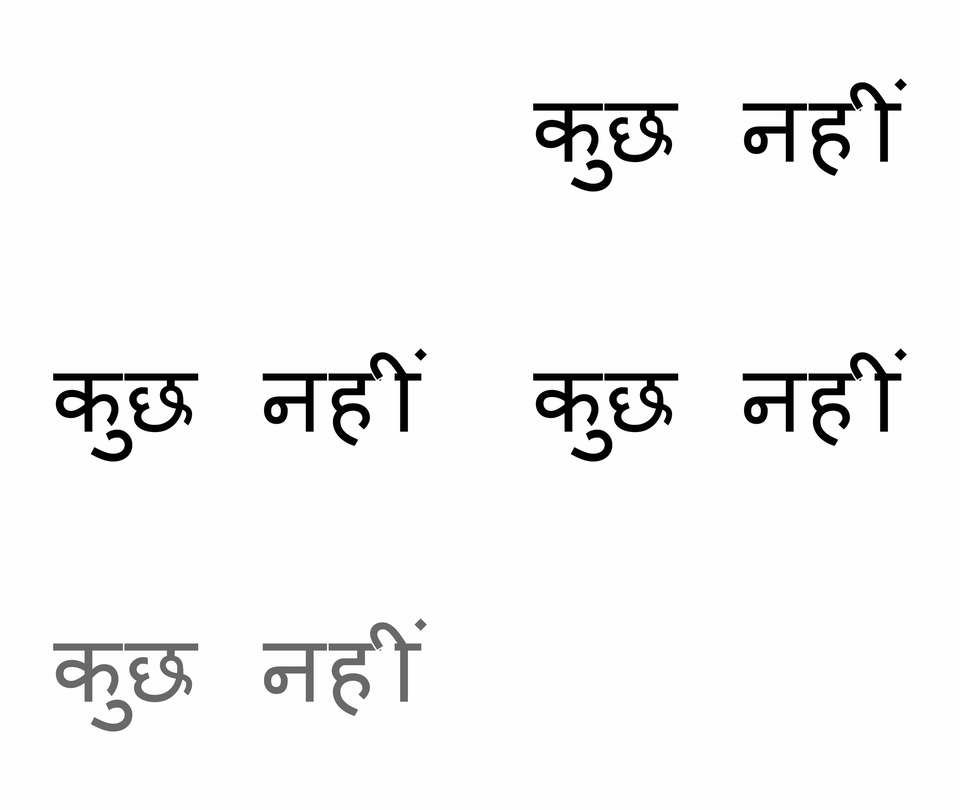
As someone who has grown up reading, writing, and speaking a language that also makes use of idiographic ideas and has one of the largest alphabet-dictionaries to exist through history, I automatically began comparing his statements regarding Chinese with Hindi and found that the links he forms and explores between the form and function of a language are extremely relatable. First and foremost, the technical similarities are obvious – both languages can express potentially every sound the human throat is capable of expelling through their vast variety of characters. Other languages, according to Xu Bing, have “clusters of different sounds that stick together. Both Mandarin and Hindi do not. (If my name were to illustrate as an example, each phonetic in “Abhika” has a distinctive character. ‘b’ would be written as ‘ब’ and ‘bh’ as a completely separate character ‘भ’.) Even though Hindi is not as pictorial/pictographic as Chinese, it derives itself from Sanskrit which follows rules similar to the Daoist traditions of building parts of a character from each other. Both languages rely heavily on emotive aspects of what words and characters represent, which isn’t a concept that has historically been taken into consideration while developing the English alphabet. I could understand what Mr. Bing meant while comparing what may seem like a sharp vertical line to a “rock falling off a cliff”, and how he realized how violent Chinese calligraphy could be while learning it. The positioning and ‘characterization’ of every part of a character (from a dot to a line; from placement of lines to line-weight and size) is anything but random, and meant to either directly pictorially symbolize an object, or represent it through these conceptualizations.
Secondly, the cultural connotations represented by Chinese writing made me realize how two Asian cultures can mirror each other in distinctive ways. Xu Bing talked about an American Author who went to China and wrote a book that mentioned the massive intersections in the roadways of commercial Chinese cities, and how people still managed to find any way they could to go around these intersections. (I have been born and raised in New Delhi, India, where the urban planners have given up on trying to introduce any mechanism for controlling roadway traffic congestion and rash driving, for they know that the public loves pretending that intersections, road markers, and traffic lights are virtually non-existent).

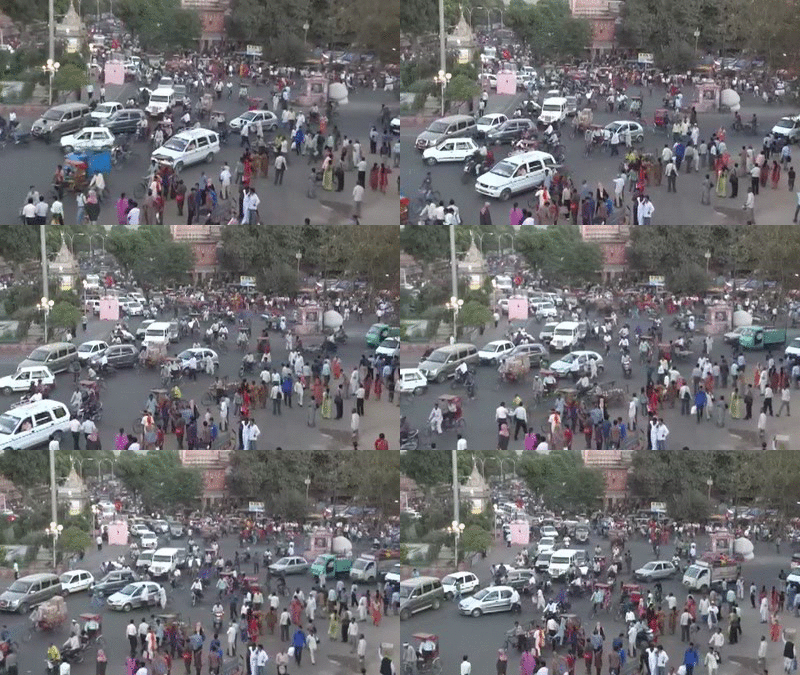
(Spot the Difference: Chinese illustration vs. GIF of Indian traffic)
Another intriguing similarity was how the act of copying plays a very important function in both cultures. An analogy claiming that Chinese painters always copied/copy paintings of earlier masters and then sign their own names applies as much to traditional Indian arts as it does to Chinese art and calligraphy. Both cultures place an extremely high value on classicism, as I discovered when Xu Bing mentioned Chinese poets’ practice of quoting lines written by previous masters to be perceived as highly educated and cultured. All these otherwise unnoticed overlaps in cultural ideas provided a different context to his work altogether. I now view ‘A Book From The Sky’ as an experiment in unboxing the various nuances about a culture/socio-political reality a character can represent through it’s physical form, rather than viewing such characters are mere tools through which to utilize written language as art. All the illegible characters in Xu Bing’s scrolls contain words of the English language, but I don’t believe this project is an attempt to make Chinese characters more “accessible” to a larger domain by anglicizing them. To me, it seems to stand more as a commentary on the power of a written character to transform the metaphysical character of what it represents (whether that be a boat or a ‘hidden’ English word).

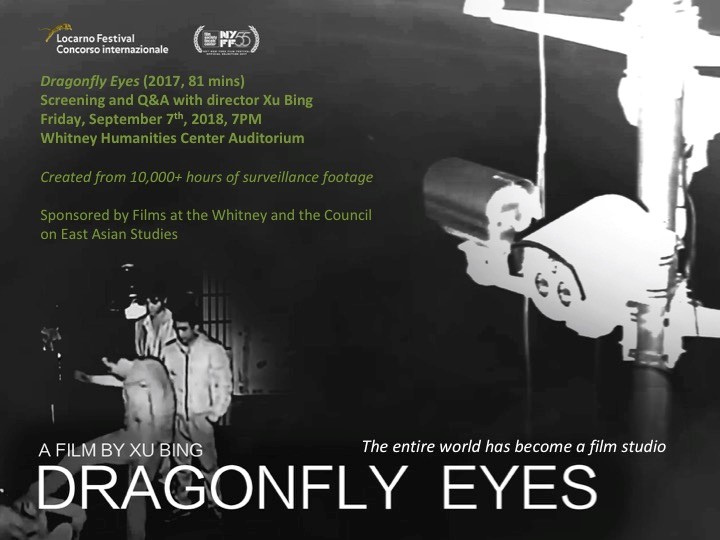
(c) The final part of the lecture focused more on his new project, ‘Dragonfly Eyes’ (a movie made without cameramen and/or actors, comprising entirely of images downloaded from the net.) Xu Bing and his team managed to collect more than 11,000 hours of footage from public surveillance videos (with extensive imagery of cows on roads; another resemblance to my city) and his ideas of working with materials that are ever-evolving and not technically his own are interesting to think about. Clearly, manipulating a pre-existing material, system, or database to conceptualize and create works of art is something Xu Bing excels at; whether it be claiming a language to serve as a vessel for his visual (rather than verbal) ideas, or forming his own narrative from video footage of the public. The question of plagiarism and the extent to which it passes in artistic realms also surfaces – to what extent can the artist shape narrative using materials that have already established their own meaning as cultural products? At what point does borrowed footage issue the status of new artwork? To what extent can an artist realistically manipulate and alter the character of these borrowed/base materials?
These questions are something that perhaps only years of experience will be able to answer for me.
- Excerpt from Character of Characters: https://www.youtube.com/watch?v=mQ1mpKlIxhQ
- More on ‘A Book From The Sky’: https://www.youtube.com/watch?v=DseIYQdjzgE
- Xu Bing’s Website: http://www.xubing.com/

